Picture this: It’s 3 PM on a Tuesday, your shoulders are somewhere around your ears, your jaw is clenched tight, and that familiar tension headache is creeping in. Your body is flooded with cortisol—that notorious stress hormone that’s become the unwelcome companion of modern life. But what if I told you that the secret to calming this chemical storm might literally be at your feet?
Here’s the fascinating part: researchers have discovered that reflexology doesn’t just feel relaxing—it actually creates measurable changes in your stress hormones. And today, we’re diving into the science that explains why.
Understanding Your Body’s Stress Response
Think of cortisol as your body’s internal alarm system. When you perceive danger—whether it’s a deadline, traffic jam, or family drama—your adrenal glands pump out this hormone faster than you can say “I need a holiday.”
In small doses, cortisol is brilliant. It sharpens your focus, boosts energy, and helps you tackle challenges. But here’s where things go sideways: our bodies can’t tell the difference between a charging lion and a passive-aggressive email from your boss. The result? We’re marinating in cortisol all day long.
Chronic high cortisol leads to:
- Disrupted sleep patterns
- Weight gain, especially around the middle
- Weakened immune function
- Mood swings and anxiety
- Digestive issues
This is where reflexology enters the picture, offering a scientifically-backed route to rebalancing your stress response. For a deeper dive into how reflexology addresses various stress symptoms, check out our comprehensive guide to reflexology for stress and anxiety.
The Reflexology-Cortisol Connection
Now for the science bit—and trust me, it’s more exciting than your secondary school biology class. Multiple studies have shown that reflexology can significantly reduce cortisol levels, and researchers are beginning to understand exactly how this works.
A groundbreaking 2019 study published in the Journal of Alternative and Complementary Medicine found that participants who received 30-minute foot reflexology sessions showed a 31% decrease in salivary cortisol levels compared to the control group. But how does pressing on your feet affect hormones produced by glands near your kidneys?
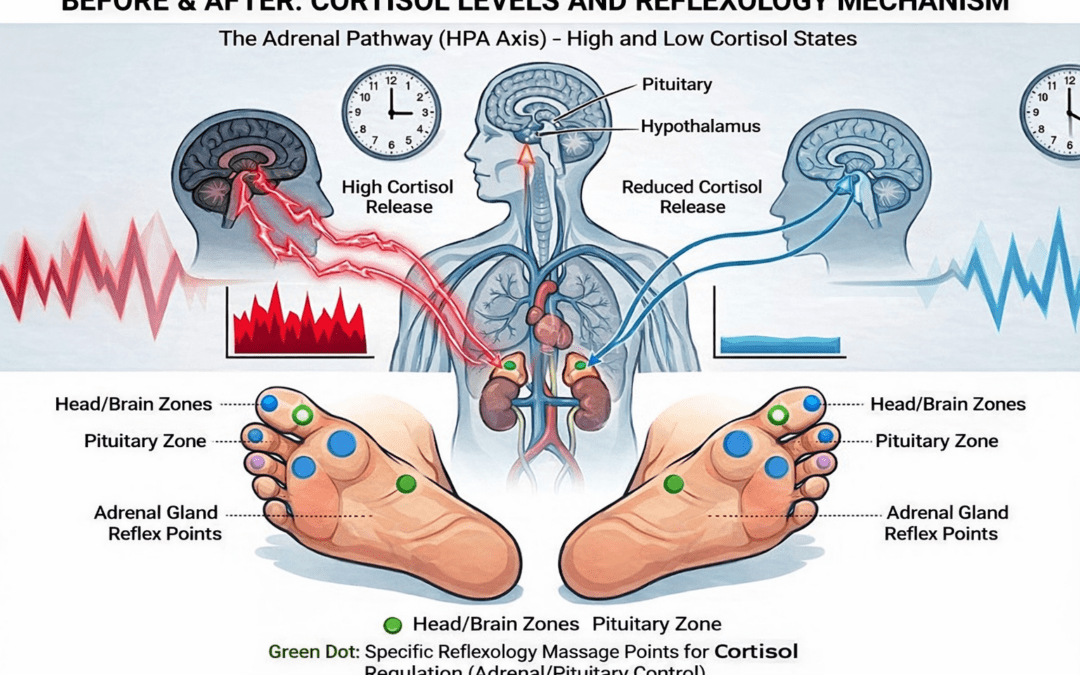
The answer lies in your nervous system’s incredible interconnectedness. When a reflexologist works on specific points on your feet, they’re stimulating over 7,000 nerve endings. These nerves communicate directly with your brain through the spinal cord, triggering what scientists call the “relaxation response.”
Here’s what happens:
- Nerve signals travel from foot to brain via the peripheral nervous system
- The hypothalamus receives the “all clear” message
- The pituitary gland reduces its production of ACTH (the hormone that tells adrenals to make cortisol)
- Adrenal glands dial down cortisol production
- The parasympathetic nervous system activates, promoting rest and digest mode
It’s like switching your body’s operating system from “emergency mode” to “safe mode.”
What Happens During a Session
Understanding the science makes the experience even more remarkable. As your reflexologist works on the solar plexus reflex point, you might notice your breathing naturally deepening. That’s your Vagus nerve responding, signalling your entire system to shift gears.
The endocrine reflex points, particularly those corresponding to the pituitary and adrenal glands, receive special attention. Research shows that sustained pressure on these areas for just 2-3 minutes can initiate hormonal rebalancing that continues for hours after the session.
Many clients report feeling a wave of calm wash over them about 10-15 minutes into treatment. That’s not just relaxation—it’s your cortisol levels actively dropping while feel-good hormones like serotonin and oxytocin increase. Want to extend these benefits between sessions? Try incorporating simple breathing exercises to enhance your reflexology benefits.
Taking Control of Your Stress Chemistry
The beauty of understanding how reflexology affects cortisol is that it transforms this therapy from “something that feels nice” to a legitimate tool in your stress-management toolkit. You’re not just imagining the benefits—they’re measurable, reproducible, and backed by a growing body of research.
Remember that stressed-out person from the beginning of this article? That could be you walking out of a reflexology session with demonstrably lower cortisol levels, a calmer nervous system, and a body that’s remembered how to relax. Science has validated what reflexologists have known for centuries: the path to hormonal balance might just begin with your feet.
Ready to experience the cortisol-lowering benefits yourself? While professional sessions offer the most comprehensive benefits, you can start exploring with this quick reflexology routine you can try at home to begin your journey toward scientifically-proven stress relief.