Did you know that Ireland loses approximately 11 million working days a year to mental health-related issues, costing the economy an estimated €1.5 billion? With nearly one in four Irish employees having taken mental health-related leave in the past year, significantly higher than the European average of 18%, companies across the country are searching for effective wellness solutions that deliver real returns. Here’s something worth considering: workplace reflexology isn’t just another feel-good initiative—when implemented consistently, it can be a genuinely measurable contribution to your wellbeing strategy.
Understanding the Numbers: The Honest Case for Workplace Reflexology
Let’s talk numbers honestly. The most rigorous evidence on wellness programmes overall comes from a Harvard University meta-analysis of 100 peer-reviewed studies, which found that a properly designed wellness programme can yield an ROI of around 3.27:1 on healthcare cost reductions and 2.73:1 on absence-related costs after about three years. The numbers vary by programme design, but the broad pattern is consistent across the literature.
For reflexology specifically, the strongest research base is around its physiological effects rather than direct ROI. A 2021 randomised clinical trial in stage-2 hypertensive patients found that foot reflexology produced statistically significant reductions in both blood pressure and heart rate compared to controls—evidence that the parasympathetic relaxation response triggered during sessions has measurable physiological effects, not just subjective ones. Other studies on cortisol have found mixed results, with some showing reductions in salivary cortisol after reflexology sessions and others finding no significant change.
When you invest in corporate reflexology programs, the underlying logic becomes clearer: by reliably activating a relaxation response in a high-stress workforce, you create the conditions in which the harder-to-measure benefits—improved focus, better team morale, reduced presenteeism—can emerge naturally over time.
Here’s what makes reflexology particularly suited to workplace settings:
- Immediate relaxation response that employees feel within the session
- No special equipment or changing rooms required
- Minimal time away from desk (30-minute sessions)
- Measurable physiological effects (blood pressure, heart rate, subjective stress)
How On-Site Sessions Work in Practice
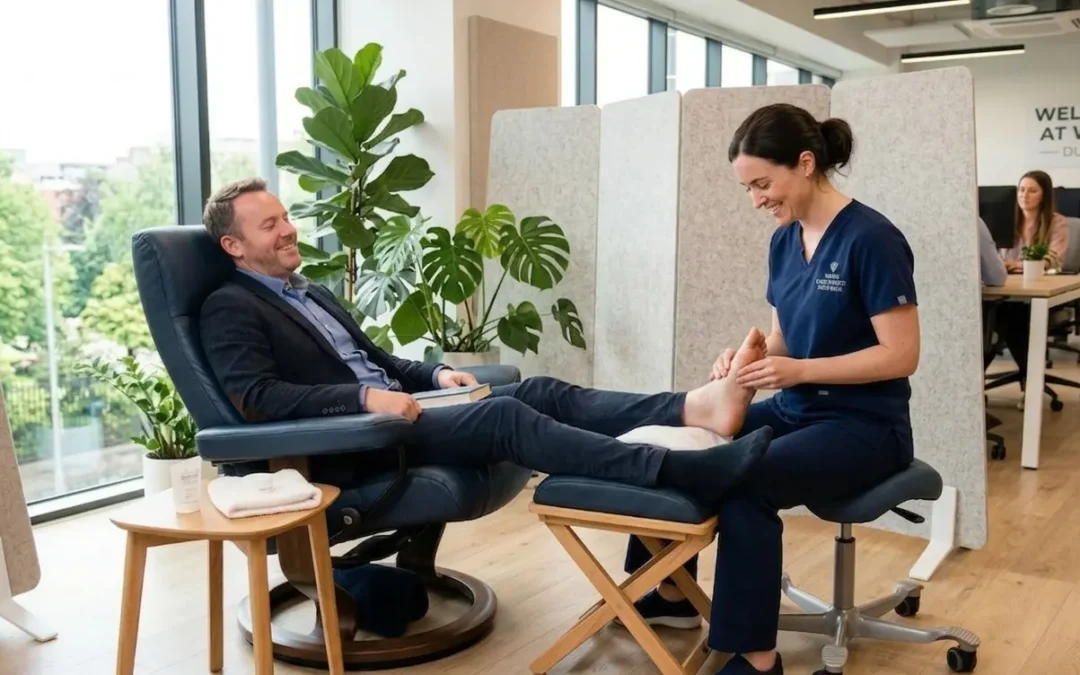
Picture this: every second Thursday, Sonia arrives at your office with her portable reflexology chair. Employees book 30-minute slots throughout the day, never leaving the building. No travel time, no productivity disruption, just focused stress relief delivered directly to your team.
The shift tends to happen gradually rather than dramatically. Within a few weeks, you’ll often notice employees actively discussing their sessions, looking forward to treatment days, and—anecdotally—reporting better sleep and reduced tension headaches. The on-site reflexology setup guide shows exactly how simple implementation can be.
What happens during workplace sessions:
- Employees remain fully clothed (only shoes and socks removed)
- Sessions focus on stress relief and energy restoration
- Each treatment is adapted to individual needs
- Complete privacy maintained in a designated quiet space
The wider effects extend beyond individual benefits. Many companies notice that teams communicate more openly when stress is being actively addressed, and managers often report that conflict-resolution conversations become easier in a workplace where wellbeing is a visible priority. It’s not magic—it’s what tends to happen when you systematically lower the baseline level of nervous-system arousal across a team.
What Irish Companies Tend to Notice
Rather than promising specific percentage improvements, the most honest summary is that Irish companies investing in regular workplace reflexology tend to report a recognisable pattern of changes over the first six to twelve months:
- More relaxed atmosphere on traditionally high-pressure days (Monday mornings, end-of-quarter, deadlines)
- Fewer reports of tension-related symptoms (headaches, neck and shoulder tightness)
- Higher engagement on employee wellness surveys
- Recruitment and retention advantage when wellness benefits are advertised
Small businesses are finding creative approaches too. Some share reflexology services with neighbouring companies, splitting costs while maintaining regular sessions. Others tie sessions to specific stressful periods or performance milestones, creating positive associations with intense work cycles.
Making the Investment Decision
Here’s the honest bottom line: workplace reflexology delivers its benefits through consistency, not intensity. The companies that get the most value start with realistic expectations and track meaningful metrics over time—sick days, employee feedback scores, engagement survey results—rather than expecting dramatic short-term changes.
Consider these decision factors:
- Current stress-related absence rates
- Employee wellness budget availability
- Company culture and openness to wellness initiatives
- Physical space available for sessions
- Willingness to commit to regular scheduling over several months
Ready to explore how workplace reflexology could fit into your business? Discover how one local company has integrated regular sessions into their wellbeing strategy in our Naas tech company case study. Both your employees and your bottom line stand to benefit when wellbeing is treated as an ongoing investment rather than a one-off perk.