Have you ever wondered if those relaxing reflexology sessions actually change something measurable in your body—not just how you feel, but what’s happening at a deeper biological level? Scientists have been asking the same question, and what they’ve found so far is genuinely interesting, though more nuanced than enthusiastic headlines often suggest.
Here’s the honest picture: your immune system does leave biological breadcrumbs. Every time it responds to something—fighting off a cold, reacting to chronic stress, working through inflammation—it changes the levels of certain markers in your blood. Researchers have been carefully exploring whether reflexology can influence those markers in measurable ways. The evidence is real, but it’s also still a work in progress.
Understanding Immune Markers: Your Body’s Internal Indicators
Think of immune markers as your body’s internal indicators. Just as a thermometer measures fever, specific tests can measure how active different parts of your immune system are at any given moment. The main players researchers look at are white blood cells—your body’s defence system—and inflammation markers like C-reactive protein and pro-inflammatory cytokines.
White blood cells come in different types, each with its own role. Lymphocytes (including T cells, B cells, and natural killer cells) handle viral threats and abnormal cells. Neutrophils tackle bacteria. When researchers want to know how the immune system is responding to an intervention, they often draw blood before and after and look at both the numbers and the activity of these cellular defenders.
Inflammation markers tell another story. While inflammation sounds purely negative, it’s actually your body’s repair response—the problem only comes when this response runs at a low chronic level over months or years, which has been linked to a wide range of long-term health issues. This is one reason why reflexology’s lymphatic drainage benefits have attracted research interest, particularly through specialised techniques like Reflexology Lymph Drainage (RLD), originally developed to support cancer patients dealing with lymphoedema.
The Research Findings: An Honest Look
Let’s look at what studies have actually measured—and where the evidence is solid versus still emerging.
One of the more rigorous studies comes from the UK and was published in 2010, when Sharp and colleagues followed 183 women six weeks after surgery for early breast cancer, randomising them into three groups: self-initiated support alone, support plus foot reflexology, or support plus scalp massage. Lymphocyte phenotyping found that CD25+ cells were significantly higher in the massage group compared to the support-only group, and the percentage of T-helper cells expressing IL4 decreased significantly in the massage group, accompanied by an increase in cytotoxic CD8+ T cells expressing IFNγ. The effects weren’t dramatic, but they were real—and they suggested that hands-on therapies can produce measurable, if subtle, shifts in immune cell behaviour.
A 2011 Korean study took a different angle, looking at self-foot reflexology in 60 female undergraduate students who completed a 1-hour session three times a week for six weeks. The results were honest and mixed: reflexology was effective in reducing perceived stress and fatigue and raised skin temperature, but cortisol levels and immune response were not statistically significantly different. This is the kind of finding that often gets left out of glowing summaries, but it matters for an honest understanding.
A 2012 pilot study with 18 nursing home residents previously treated for cancer compared 20-minute sessions of Swedish massage and reflexology. Both interventions resulted in significant declines in salivary cortisol and pain, and improvements in mood. The sample was small, but the result is consistent with broader literature showing that hands-on therapies can dampen the stress response—which in turn has well-established links to immune function.
What this body of research suggests is something more measured than “reflexology boosts immunity.” It suggests that reflexology can reliably reduce subjective stress and, in some populations, produce modest measurable effects on stress hormones and immune cell behaviour. The strongest and most consistent finding across studies is the relaxation response itself.
What This Means for You
So what do these laboratory findings mean for your everyday life? The most honest answer is that reflexology is best understood as a stress-modulating therapy with potential downstream benefits for immune resilience—not as a treatment that will dramatically reshape your blood markers in a single session.
This matters because chronic stress is one of the better-documented suppressors of immune function. By calming the nervous system, supporting deeper sleep, and triggering a parasympathetic relaxation response, reflexology may help your body operate from a less stressed baseline—and a less stressed body is generally one whose immune system can do its job more effectively.
When comparing different wellness approaches, it’s worth knowing how reflexology stacks up against other options. Our detox methods comparison explores how reflexology compares to popular alternatives like detox foot baths, which have far less scientific support.
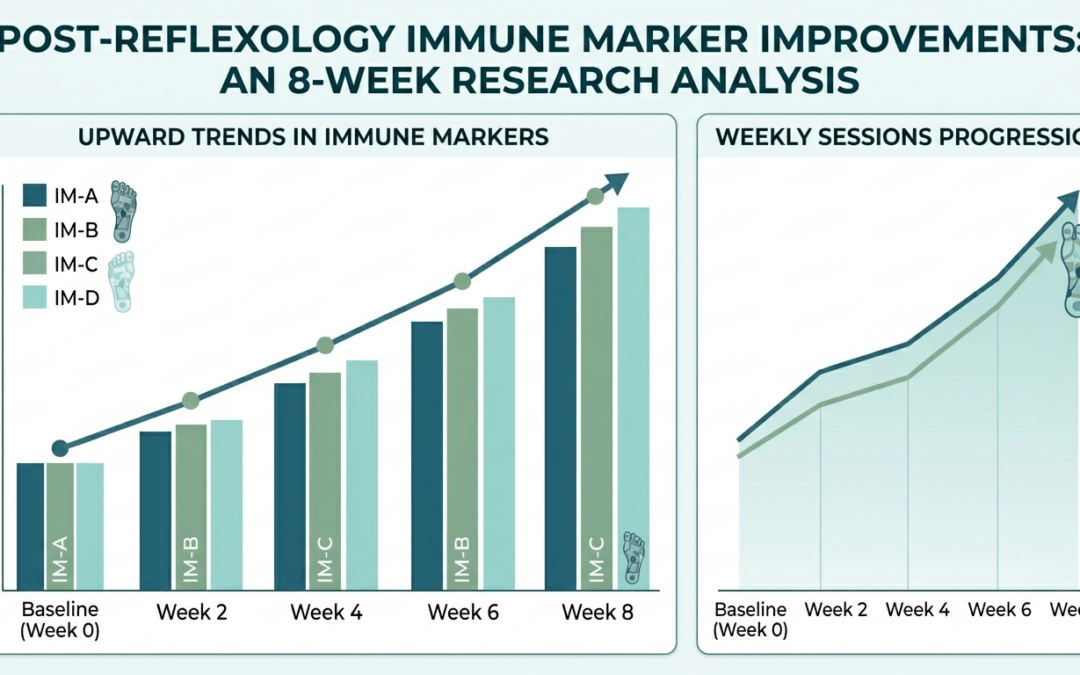
The timing matters too. Across the studies that show measurable benefits, consistency is key—weekly or bi-weekly sessions over several weeks tend to show more pronounced effects than occasional, sporadic treatments.
Taking Action on the Evidence
The honest summary? Research suggests that reflexology can produce measurable, if modest, positive effects on stress markers and certain immune indicators—particularly in people dealing with cancer recovery, chronic stress, or related conditions. It is not a substitute for conventional medical care, and the evidence base remains smaller than enthusiastic claims sometimes suggest. But it is real, peer-reviewed, and genuinely worth taking seriously.
For most people, the most reliable benefit of reflexology is what you might already feel after a single session: a deep relaxation response that lowers the body’s stress signals, which over time may give your immune system better conditions in which to do its work.
Ready to experience these benefits for yourself? Explore our complete guide to immune and detox benefits of reflexology and discover how this ancient practice meets modern science. Remember, the best research finding is the one you experience personally. Call to book a session!