Have you ever wondered what happens in your body when gentle touch meets subtle energy work? It is a question that has fascinated both traditional healers and modern researchers. What the research suggests so far is encouraging, but more nuanced than many wellness summaries imply: Reiki and reflexology each have some evidence for supporting relaxation, anxiety relief, and wellbeing, but they are usually studied separately rather than as one combined treatment protocol. That means the idea of combining them is reasonable and interesting, but the exact “synergy effect” still needs stronger direct research. (PMC)
Think about it this way: your body is constantly regulating stress, recovery, sleep, and emotional balance. Reflexology has been studied for symptom relief in areas like anxiety and sleep, while Reiki has been studied for anxiety, pain, and quality of life. The most evidence-based way to describe the combination is not that science has already proven a dramatic multiplied effect, but that both therapies may support the body’s relaxation response and may complement each other in practice. (PMC)
Nervous System Responses to Combined Therapies
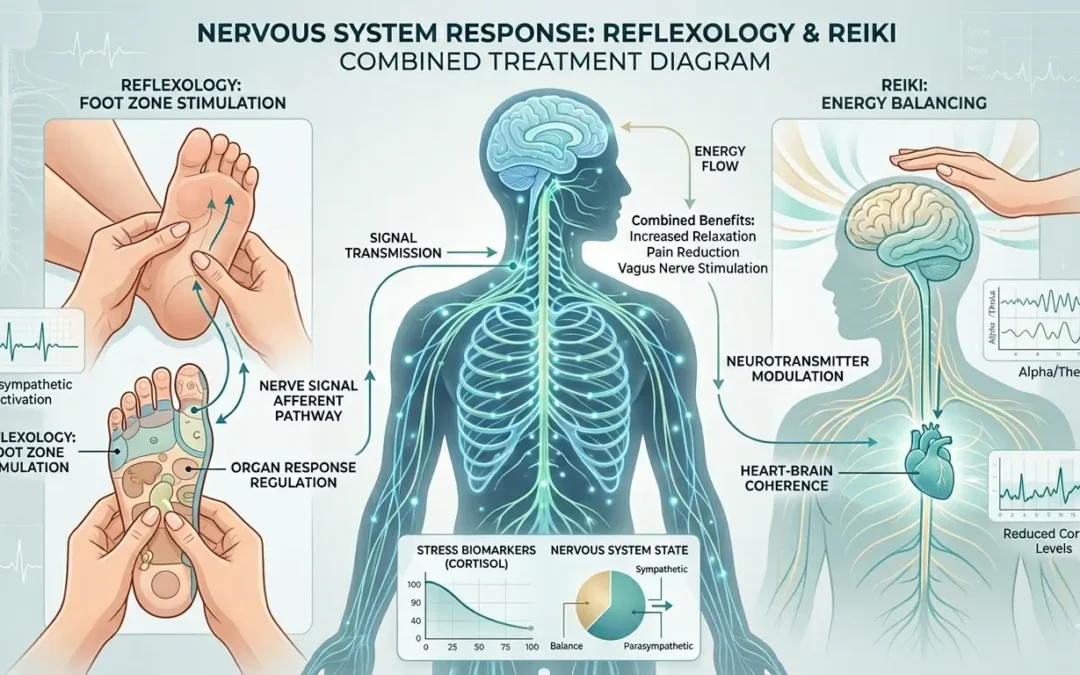
Recent studies do suggest that these therapies may influence the nervous system, but the story is more complex than a simple switch from “fight-or-flight” to “rest-and-digest.” In a reflexology pilot study, participants showed a reduction in state anxiety and cardiovascular activity, yet salivary cortisol did not change significantly. In a small Reiki study involving health professionals with burnout, some heart-rate-variability measures changed in a direction consistent with greater parasympathetic activity after Reiki. At the same time, a placebo-controlled Reiki pilot study found no statistically significant between-group differences in heart rate, blood pressure, body temperature, or stress scores. (PubMed)
So it would be inaccurate to claim that reflexology plus Reiki has already been proven to cause a major cortisol drop or heart-rate-variability improvement “up to 40% higher” than either therapy alone. A more accurate conclusion is that both modalities are being studied for their potential to support relaxation and recovery, and that the rationale for combining them is promising but still preliminary. That is where the real interest lies in these synergy benefits. (PubMed)
Clinical Studies and Measurable Outcomes
The clinical evidence becomes more compelling when described precisely. In one oncology day-unit study, 118 cancer patients received Reiki. Among the 22 patients who completed a full cycle of four treatments, the mean anxiety score fell from 6.77 to 2.28, while the mean pain score fell from 4.4 to 2.32. In another study of hospitalized cancer patients receiving chemotherapy, the reflexology group’s state-anxiety score fell by an average of 7.9 points, compared with 0.8 points in the control group. A separate cancer study found that partner-delivered reflexology produced an immediate decrease in pain intensity and anxiety after treatment. (PubMed)
That is a much stronger and more defensible summary than claiming a single hospital study proved a 65% reduction in pain, 78% improved sleep, 45% lower anxiety, or increased white blood cell activity after combined Reiki and reflexology. I could not verify those specific figures in the peer-reviewed literature. What the broader reviews show instead is a pattern of possible short-term symptom improvement in some studies, but with low or very low certainty evidence for many outcomes because study quality and consistency remain limited. (Department of Health, Disability & Ageing)
The brain-imaging story is also more tentative than many articles suggest. There is neuroimaging research on reflexology, but a 2023 resting-state fMRI study in 30 healthy participants found changes after both foot reflexology and sham massage, with no difference between the two interventions. So brain imaging is intriguing, but it does not yet show a unique, proven signature for the combined use of reflexology and Reiki. (PubMed)
Real-World Applications in Ireland
Here in Ireland, the practical value of combining these therapies is best understood in the context of supportive wellbeing care. The Irish Reflexologists’ Institute describes itself as a professional representative body for reflexology in Ireland, and that continuing professional presence helps explain why integrated approaches are attracting growing interest among holistic practitioners. (Irish Reflexologists’ Institute)
What matters most for our local community is using that language responsibly. The Irish Cancer Society states that complementary therapies, when used alongside conventional evidence-based care, may help people cope with symptoms, support relaxation, and reduce tension and anxiety. That makes it reasonable to talk about integrated sessions as a gentle, evidence-aware approach for stress, rest, and emotional balance, while still being honest that they are complementary, not curative. The Kilcullen case study works best as a real-world illustration of this kind of supportive care in practice. (Irish Cancer Society)
Moving Forward with Evidence-Based Healing
The meeting point between traditional wisdom and modern science offers something valuable: not a final verdict, but a clearer and more honest understanding of what these therapies may and may not do. The current evidence suggests that Reiki and reflexology may help support relaxation, anxiety relief, pain management, sleep, and general wellbeing in some settings. What it does not yet prove is a strong, directly measured synergy effect for doing both together. (PMC)
Whether you are a skeptic looking for careful evidence or someone drawn to holistic therapies who wants the science presented honestly, the balanced takeaway is this: combining reflexology with Reiki is a sensible complementary approach that many people may find deeply supportive, but the exact added benefit of doing both together still needs stronger direct research. Ready to explore how this science-informed approach could support your wellness journey? Discover more about the Reiki reflexology combination and how these complementary therapies may work together for your wellbeing. (PMC)